.png)
 2 hours ago
4
2 hours ago
4
Federal judges in Minnesota have rejected the Justice Department’s charges against some of the anti-ICE agitators who invaded a church during service earlier this month, and others have released multiple defendants, even as the Justice Department has appealed some of these decisions.
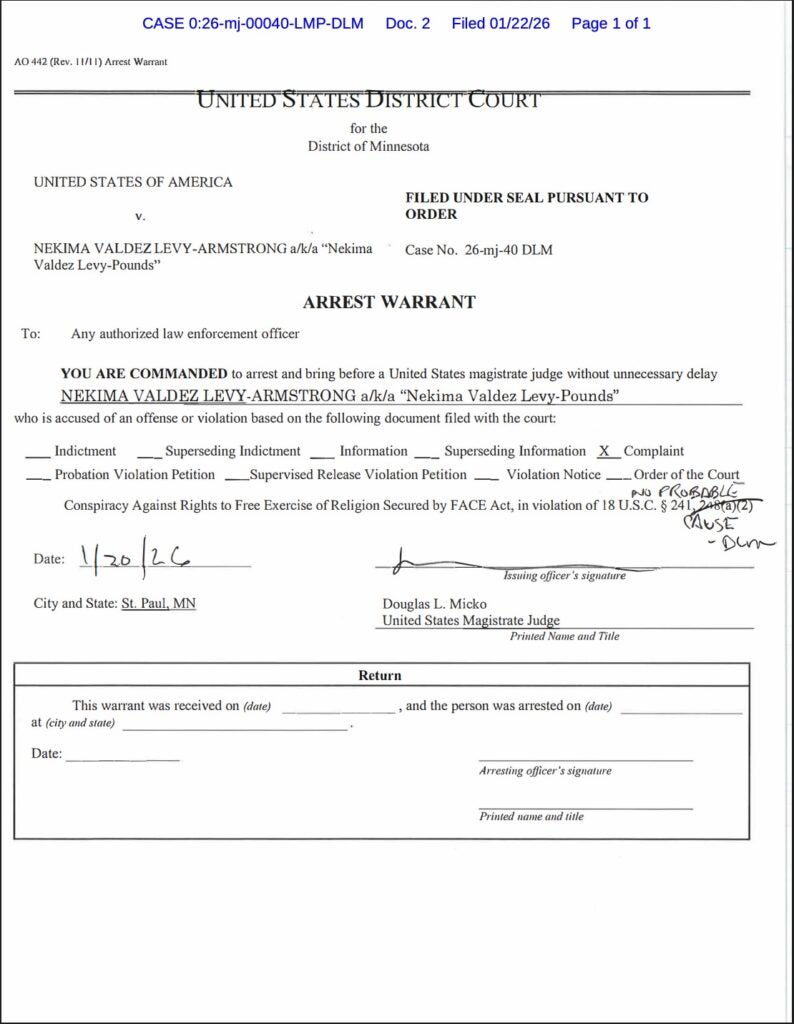
After the Justice Department filed charges against eight agitators for depriving churchgoers of their rights to exercise their religion under the First Amendment, Magistrate Judge Douglas L. Micko declined to issue arrest warrants for five of the defendants, and struck down charges against the others.
The Justice Department appealed the denial of the arrest warrants, a move that Patrick Schlitz, chief judge of the U.S. District Court of Minnesota, said is unprecedented, at least in the courts under the U.S. Court of Appeals for the 8th Circuit.
The Justice Department claimed that the agitators would likely disrupt a church service again, and many of the leaders have stood by their decision to disrupt the service.
Here are five things to know about the cases.
1. The Church Invasion
Between 30 and 40 anti-ICE agitators interrupted a Sunday service at Cities Church, a non-denominational Christian church in St. Paul, and shouted, “Justice for Renee Good!” as they surrounded members of the congregation.
Videos of the incident show the pastor and others repeatedly asking the agitators to leave, and the agitators chanting, “Who shut this down? We shut this down!”
According to the charging document, a member of the congregation said worshippers were “terrorized, our children were weeping.” One woman broke her arm. Agitators blocked about 50 members of the congregation from exiting, making it “nearly impossible for parishioners to get out and leave.”
The document also mentions that agitators prevented congregants from getting to their children, and one of the agitators reportedly told young children, “Do you know your parents are Nazis, they’re going to burn in hell?”
2. The Defendants
On Thursday, Attorney General Pam Bondi announced that law enforcement had arrested Nekima Levy Armstrong, Chauntyll Louisa Allen, and William Kelly, who posted videos of the invasion online under the handle “DaWoke Farmer.”
Yet Magistrate Judge Micko rejected arrest warrants for the other five defendants. While the published version of the charging document redacts the defendants’ names, clues in the document suggest that Lemon and Jamael Lundy each face charges.
The charging document quotes an exchange between Lemon and Cities Church Lead Pastor Jonathan Parnell. The pastor tells the former CNN host: “It’s shameful to interrupt a public gathering of Christians in worship.”
The document also notes that one defendant “identified himself as a current candidate for Minnesota State Senate, District 65.”
Lundy, the intergovernmental affairs director for the Hennepin County Attorney’s Office, is running to represent that district in the Minnesota Senate, and he appeared in videos with the organizers before the church invasion.
3. Church Invader Charges
The Justice Department brought two charges against the church invaders: deprivation of rights under the Ku Klux Klan Act and violation of the Freedom of Access to Clinic Entrances or FACE Act. The Klan Act criminalizes depriving people of their civil rights, such as the free exercise of religion, while the FACE Act protects access to churches.
Judge Micko approved the warrants for Armstrong, Allen, and Kelly, but he struck the FACE Act charges, writing, “No probable cause.”
Micko denied the arrest warrants for the five other invaders.
Lemon’s attorney, Abbe Lowell, praised the magistrate judge’s decision.
“The magistrate’s reported actions confirm the nature of Don’s First Amendment protected work this weekend in Minnesota as a reporter,” Lowell told Fox News Digital.
 Screenshot
4. The Appeal
Patrick Schiltz, chief judge of the U.S. District Court of Minnesota, explained in a letter how the Justice Department went about appealing Micko’s decisions.
“It is important to emphasize that what the U.S. Attorney requested is unheard of in our district or, as best I can tell, any other district in the Eighth Circuit,” Colloton wrote. If the prosecutor does not like a magistrate judge’s decision, he or she can either improve the filing and present it to the same magistrate judge, or present its case to a grand jury to seek an indictment.
Colloton said he would not make a decision until conferring with his colleagues at a bench meeting, but the meeting got postponed. He plans to make a decision after a lunch meeting on Tuesday.
Schiltz noted that the U.S. attorney’s office stated that “there are plans to disrupt Cities Church again on Sunday.” He said that the government “does not explain why the arrests of five more people—one of whom is a journalist and the other his producer—would make Cities Church any safer, especially because that would still leave ‘dozens’ of those who invaded the church on Sunday free to do it again.”
5. Church Invaders Released
The Sherburne County Jail, which had held the defendants, released them Friday after District Judge Laura Provinzino rejected the government’s appeal. Prosecutors claimed that Armstrong and Allen posed flight risks and requested that the court hold them or require them to post $10,000 cash bail.
Judges often grant pretrial detention in cases where defendants are accused of violent or other serious crimes or pose a flight risk.
Harmeet Dhillon, assistant attorney general for civil rights at the Justice Department, pledged to aggressively pursue these cases.
“We’re going to pursue this to the ends of the earth,” Dhillon told Megyn Kelly about the cases, particularly the charges against Lemon, the former CNN host.
Cities Church’s attorneys have suggested that they are considering civil cases against the church invaders.
The post 5 Things to Know About the Minneapolis Church Invasion Case appeared first on The Daily Signal.







 English (US)