.png)
 1 hour ago
6
1 hour ago
6
In recent years, China’s People’s Liberation Army Air Force (PLAAF) has kept a near constant presence around Taiwan. However, from Feb. 28 to March 6 there were no PLAAF sorties near the island for seven days. This was the first time there has been over four consecutive days without PLAAF activity near Taiwan since seven consecutive days of no sorties from June 30 to July 6, 2022.
This lull is not an isolated event, but part of a longer running drop of Chinese military activity near Taiwan.
This lull in Chinese military activity comes at a sensitive time amid a
U.S. conflict with Iran and ahead of a planned summit between President Donald Trump and Secretary General Xi Jinping of China, originally set for the end of March and now postponed until after the United States’ “active part in the Iran conflict is over.”
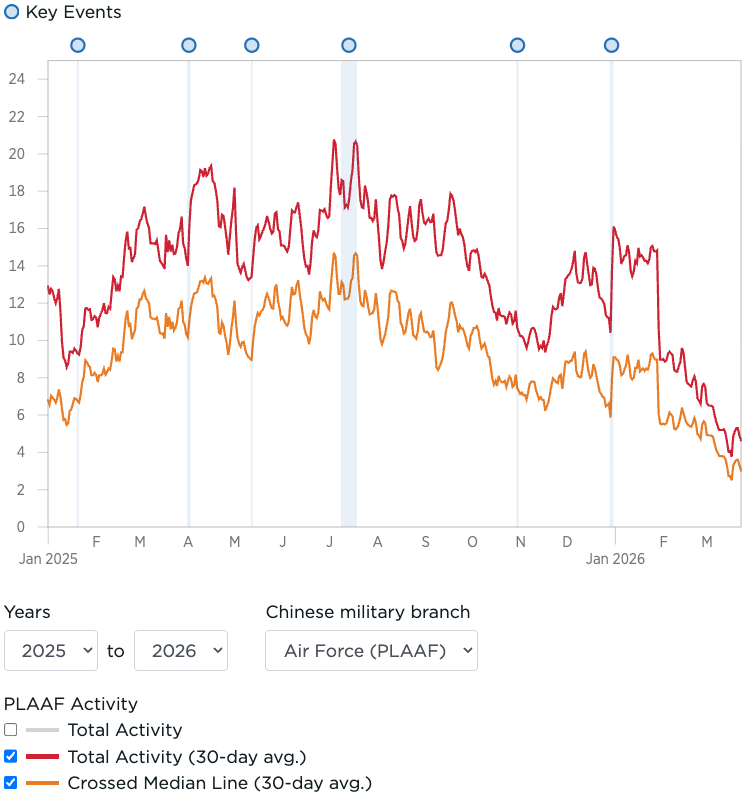
Over the past few years, the Heritage Foundation has tracked the People’s Liberation Army’s (PLA) continuous presence and military drills around Taiwan. Those efforts complement research that has noted Beijing’s sustained preparation for a possible invasion of Taiwan. Interestingly, China’s military activities have decreased markedly below seasonal averages around Taiwan since the new year.
On the other hand, meanwhile PLA Navy levels have remained steady at historic seasonal average levels, averaging around five to seven ships near Taiwan daily. However, this is not the case for the PLAAF, which has seen a precipitous drop in its activities near the island.
The first quarter of 2026 saw PLAAF levels below previous seasonal averages. For example, of the first 70 days of 2026, 47 included five or fewer aircraft sorties near Taiwan, and 22 of those days had no PLAAF activity near Taiwan. This is compared to the first 70 days of 2023-2025, which had a combined 3 days of no PLAAF activity and recorded only 13 days of five or fewer sorties.
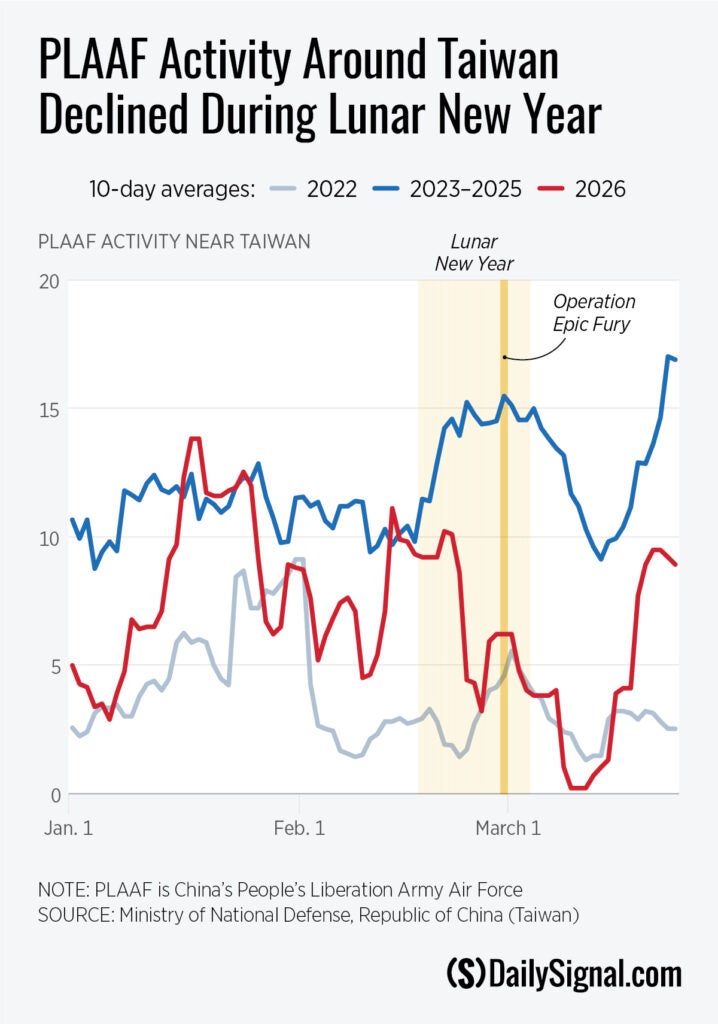
The drop off in Chinese military activity around Taiwan was namely in the second half of February and persisted into the first two weeks of March.
Looking at the running 10-day average for this timeframe, PLAAF levels in 2026 were less than half that of the past three years. The levels of activity from this timeframe was more in line with those before the massive increase of PLAAF sorties in response to Rep. Nancy Pelosi’s Taipei visit in August 2022. During this lull there was still a day with 30 PLAAF sorties around Taiwan on Feb. 26. This would follow normal routines of such scaled PLAAF sorties near Taiwan happening about every 1-3 weeks.
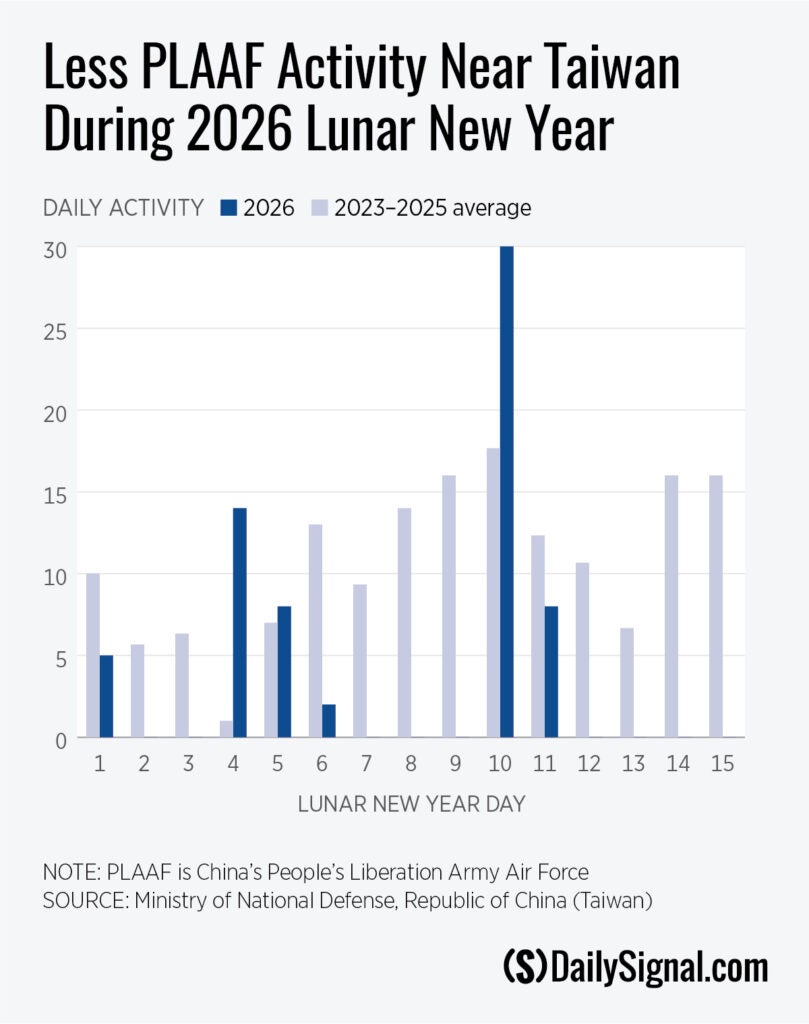
During this time of low activity came the Chinese Lunar New Year, which ran from Feb.17 to March 3. Nine of the 15 days of Lunar New Year celebrations had no PLAAF activity around Taiwan. This differs from the last two Lunar New Years, which had levels consistent with the seasonal averages at around 10 aircraft sorties in 2024 and 13 in 2025. However, the lull in this year’s celebration persisted even after the holiday. So the lull had to be more than holiday time off.
PLAAF activity would rise in the third week of March, returning to levels more in line with previous seasonal averages.
Another key event that happened during this lull was Operation Epic Fury. This operation saw combat initiated February 28 against Iran. PLAAF activity around Taiwan was low before the operation and saw no noticeable increase in response despite China condemning America’s actions in Iran. Perhaps instructive, Beijing would express a desire to continue bilateral relations with America. Therefore, this lull of activity does not seem to be related or in response to Epic Fury.
Anther theory behind the previous lull in Chinese military activities was the impact of war with Iran on the supply of oil. Even though the dip in PLAAF activities started before Epic Fury, the operational lull could have been an effort to conserve fuel in case conflict started.
Due to the conflict in Iran, oil prices spiked drastically settling in recent days to above $100 a barrel as compared to less than $80 before the war.
With an estimated 13% of China’s oil imports are from Iran, China has possibly needed to tap into its massive oil stockpile, an estimated at 900 million barrels. However, Chinese naval patrols near the Scarborough Shoal and the Senkaku Islands and near Taiwan remained unchanged throughout. Additionally, activities would rise to average levels in the third week of March.
It’s likely then that oil scarcity was not a leading factor for the lull in PLAAF activities.
Another hypothesis for the PLAAF lull is to set conditions for the upcoming Trump and Xi summit; originally planned for March 31 but since postponed. This summit is to held in Beijing, and as such the first for a U.S. president since Trump’s visit in 2017.
Both leaders are likely calculating that the summit can have a positive impact on their interests, and both leaders have expressed positive opinions about U.S.-Sino relations in recent weeks. Additionally, Treasury Secretary Scott Bessent met with the Chinese vice premier in mid-March leading up to the summit.
In the interim, Trump has requested that the summit be postponed due to Operation Epic Fury.
However, PLAAF activities around Taiwan were not affected by past summits between Xi and U.S. presidents. For example, PLAAF activities remained the same before and after Xi and President Joe Biden’s meetings in 2022, 2023, and 2024.
The one exception would be Trump’s meeting with Xi in October 2025. The ten days prior to that meeting had lower levels of PLAAF activity around Taiwan, which then spiked to 25 sorties the day before their meeting given the significance of that summit intentional; a likely move buttressing Xi’s diplomatic position.
Preparing the political context ahead of the summit may be an explanation for the recent PLAAF lull. If this were the case, low activity levels should be expected to persist until the summit. Interestingly, there has been an increase in PLAAF activities from the third week of March. However, this rise of PLAAF levels happened around the same time the White House stated the summit may be postponed.
Alternatively, is the possibility that the lull is due to internal Chinese military reasons.
One theory is that ongoing political purges in the Chinese military could be affecting operations. However, purges have not caused drastic drops of PLA activities before, even when the head of the Eastern Theater Command was ousted.
Or, the PLAAF lull is due to changing operational and training patterns. This would explain why a lowering of activities has only been seen in the PLAAF, and not the PLA Navy. This is more compelling given the Southern Theater Command responsible for the South China Sea is believed to be reforming its training routines.
Regardless of Beijing’s reasoning, low PLAAF activity levels are likely temporary and the intention impossible to fully discern outside China. So, vigilance is required to discern Beijing’s next move. Making any reciprocal moves to reduce U.S. military presence in the region would be unwise–especially any reduction in special reconnaissance operations (SRO) in international waters and airspace near China.
Even during times of reduced Chinese military activities, Taiwan must remain on guard, and the U.S. must remain vigilant.
For more information on PLA activities near Taiwan, see the interactive activity tracker: click here.
The post A Diplomatic Gesture or Something Else: Examining the Temporary Lull in Chinese Military Activity Around Taiwan appeared first on The Daily Signal.









 English (US)