.png)
 1 hour ago
2
1 hour ago
2
The Religious Liberty Commission held a hearing at the Museum of the Bible on March 16 to examine religious liberty issues in health care and social services. Across multiple panels, witnesses described professional and legal consequences they said followed decisions to practice their faith.
Testimony came from parents, physicians, counselors, and faith leaders who addressed topics including gender ideology, abortion, vaccines, and assisted suicide. Several witnesses said government mandates and institutional policies have made it increasingly difficult to practice their religion without fear of losing a job, professional standing, or access to education.
Gender Ideology in Institutions
Kaley Chiles, a licensed professional counselor in Colorado, testified about state laws governing counseling conversations involving gender identity. She said the law required her to affirm gender transitions for minors, even when that conflicted with a client’s goals.
“Young people wrestling with identity deserve counselors who are free to speak, ask questions, listen with compassion, and walk alongside them in their search for hope and restoration,” Chiles said.
Physician assistant Valerie Kloosterman told the commission she lost her job after refusing to complete mandatory, company-wide training at the University of Michigan that required affirming statements about gender identity. Kloosterman said she requested religious accommodation but was denied and ultimately terminated for declining to comply.
The witnesses said their experiences reflect growing pressure on professionals when institutional policies conflict with religious conscience.
Abortion
Abby Sinnett, a nurse practitioner and founder and CEO of Bella Health + Wellness in Colorado, testified about state restrictions on abortion pill reversal. Sinnett said Colorado became the first state to prohibit prescribing progesterone to women who took the first abortion pill and later decided to continue their pregnancies.
“Unfortunately, lawmakers in my home state of Colorado disagreed … they became the first state … to make it illegal to give progesterone for abortion pill reversal,” Sinnett said. Progesterone remains legal in Colorado for other medical uses, including infertility treatment and miscarriage prevention.
Susan Bane, an obstetrician-gynecologist, testified about practicing medicine as a Catholic physician and resisting pressure to participate in abortion procedures during her training and career.
“As an OBGYN, I take care of two patients — a maternal and a fetal patient. A mom and her baby,” Bane said. “So, the direct and intentional killing of one of those patients is never health care. It never was, and it never will be.”
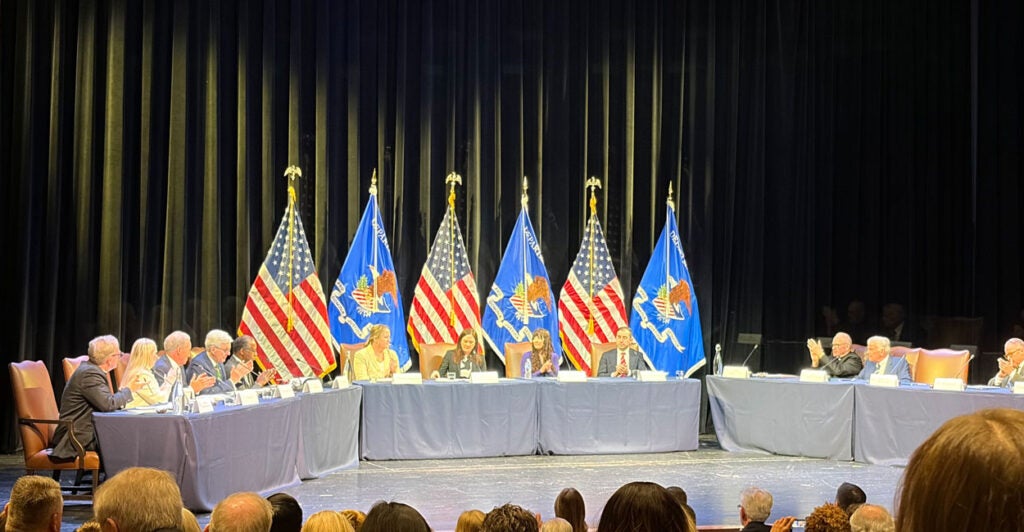 Witnesses testify before the Religious Liberty Commission during its sixth hearing at the Museum of the Bible in Washington on Monday, March 16, 2026. (Photo: Reagan Campbell)
Assisted Suicide
Dr. Leslee Cochrane, a hospice physician in California, testified against physician-assisted suicide laws that require doctors who object on moral grounds to document requests and refer patients to willing providers.
“Assisted suicide is never medically necessary to manage pain,” Cochrane said. “The American Medical Association has stated that it’s fundamentally incompatible with a physician’s role as a healer and would pose grave societal risk.”
Cochrane described caring for a deeply religious patient whose family pressured her to consider assisted suicide despite not being in pain, saying the case demonstrated how vulnerable patients can be influenced and why physicians must retain the freedom to protect patients and follow their conscience.
Dr. Kenneth Prager, a pulmonologist and director of clinical ethics at Columbia University Medical Center, distinguished between withdrawing life support and intentionally causing death.
He warned that legalizing medical aid in dying may “lead to a slippery slope,” citing expanded eligibility for assisted suicide in Canada and parts of Europe, and emphasized protecting religious freedom in end-of-life care.
Vaccine Mandates and Education
Several parents testified that religious objections to childhood vaccinations resulted in their children being excluded from school. One mother said New York’s 2019 repeal of the religious exemption barred her children from public education despite her good health, while students with medical exemptions were still allowed to attend.
The commission’s findings will inform ongoing debates over how state and federal policies should balance religious freedom with evolving medical and social standards.
The post Religious Liberty Commission Hears Testimony on Faith Conflicts in Health Care, Social Services appeared first on The Daily Signal.










 English (US)