.png)
 1 hour ago
1
1 hour ago
1
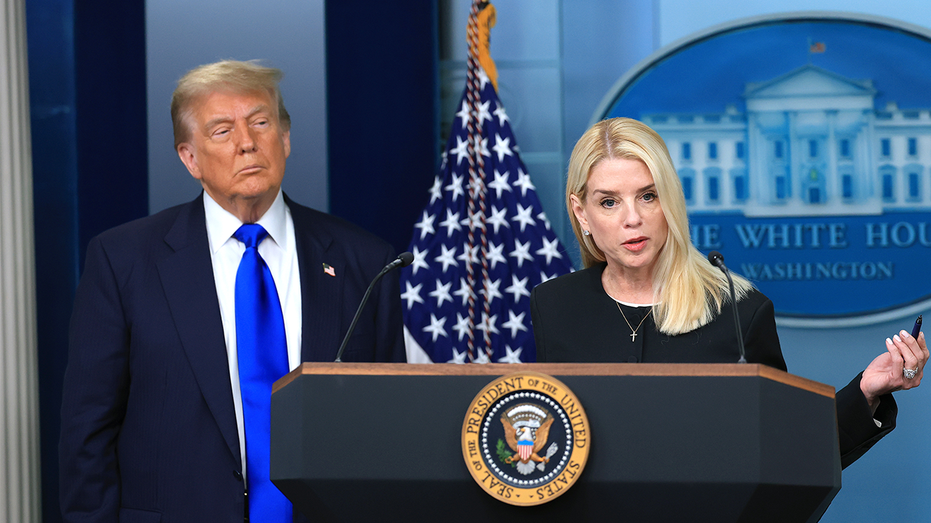
The overstuffed white binders appeared a few moments before Attorney General Pam Bondi exited her motorcade, and strode through the horseshoe entrance of the Rayburn House Office Building.
Roll Call photographer Tom Williams and I stood in the hallway, negotiating our positions for Bondi’s entrance. Williams would position himself on the far side. I slid to the wall nearest the horseshoe entrance. Ali Vitali of MS NOW and Jay O’Brien of ABC worked the sidewall.
A coterie of Bondi’s aides appeared. One bogged down by the massive binders.
BONDI HEARING DEVOLVES INTO CHAOS OF SHOUTS AS AG ACCUSES TOP DEMOCRATS OF 'THEATRICS'
"Let her get into the room," instructed the aide.
I politely reminded the aide that the corridor was an open hallway on Capitol Hill. It wasn’t closed off by the U.S. Capitol Police. So, tossing questions at the Attorney General was fair game.
And, thus began another dance between reporters, security details, the U.S. Capitol Police, aides and Cabinet members when they appear for major Congressional hearings.
At the time, we had no clue what was in the binders. But you couldn’t ignore the sheer size of them.
It’s not uncommon for aides to haul in briefing books for a principal when they testify. However, no one has seen binders like this since Kinko’s was still in business.
The contents of what the binders contained was about to play a central role in Bondi’s testimony to the House Judiciary Committee.
But the first charge of the morning was to query Bondi. There was so much going on. All of which were subjects that the Attorney General could address.
Speaking of files…
Bondi wasn’t there to testify about the Epstein files, per se. But Democrats – and one Republican – would make the Justice Department’s release of partially redacted documents the focus of the hearing. So there was plenty to ask Bondi about that.
DOJ’S EPSTEIN DISCLOSURE DRAWS FIRE FOR WEBSITE GLITCHES, MISSING DOCUMENTS, REDACTIONS
However, there were overnight developments from Arizona. Authorities detained a person near the Mexico border in connection with the disappearance of Nancy Guthrie. What Bondi might know about the FBI’s role in this was worth a question.
Then, there was a cryptic alert that officials were shutting off the airport in El Paso to all air traffic for ten days. Was there a threat of terrorism? Something about cartels? Finally, a story broke overnight that the Justice Department sought to indict six Democratic lawmakers for their video telling service members they didn’t have to comply with unlawful orders. A District of Columbia grand jury refused to indict any of them.
So the press corps waited for Bondi and her security detail to breeze through the door. We’d have about a minute to pepper her with questions as she walked from the horseshoe entrance to a back anteroom.
Reporters must be strategic with such brief "walk-and-talks." Rapid, Gatling gun-like questions. Succinct. Straight to the point. And agile enough to skip to the next line of inquiry if the figure arriving on Capitol Hill doesn’t answer or gives a brief response.
In another universe, I may have started with Epstein. But the Nancy Guthrie story has consumed the nation for weeks now. There was a development overnight. Nearly every story on the planet always occupies a lane somewhere on Capitol Hill. The Nancy Guthrie saga was no exception.
I had positioned myself on the inside track as we walked down the hall. Able to sidle up close to Bondi as she moved through the building.
"Madam Attorney General, any comment about the investigation of Guthrie? Any update on that right now?" I began, getting to Bondi first.
"Yeah, I can't talk about that now. Praying for Savannah and her family," replied Bondi.
Check. Moving on.
"What happened in El Paso? Why did they close off El Paso? Is that something you don't know about? Or you just can't comment?" I asked.
"I cant discuss it," responded Bondi.
EPSTEIN FILES EXPLODE OPEN AS DOJ DETAILS DISCOVERY OF POWERFUL FIGURES AND MORE THAN 1,200 VICTIMS
Then, the main event.
"And what about the Epstein files? A lot of members have been upset that some of these files have not been fully unredacted. What do you say to that?" I inquired.
"We're going to discuss that today," answered Bondi.
I backed off to allow my colleagues a chance to pose questions.
"But why was certain information redacted that's against the nature of the law? Why was certain information redacted that's against the law?" asked Vitali.
No response.
So I tagged back in, returning to the initial lines of questioning.
"Did you get any updates overnight on the Guthrie investigation? Were they keeping you informed overnight on that? And when did you first find out about the El Paso situation? When did you first hear about the El Paso situation, Madam Attorney General?"
Bondi was silent.
The scrum processed down the hall, camera operators and reporters bumping all over one another, edging backwards. A semi-blob of security personnel slightly shielded Bondi.
But the end was near. The throng approached the backdoor to the Judiciary Committee. Bondi would soon turn right and disappear inside.
Just enough time for one final topic.
"What about the attempt to prosecute the six lawmakers? Any comment on that failed grand jury indictment?" I hollered.
"I'll refer that to U.S. Attorney Pirro," replied Bondi, referring to U.S. Attorney for the District of Columbia Jeannine Pirro, who tried to indict the six.
"Do you know why that went wrong?" I asked.
But that was it. The shot clock expired.
Bondi ignored the question, turning right with her security detail and retreating into the anteroom.
When he hosted Meet the Press on NBC, late host Tim Russert would sometimes boast that they had the Vice President or Secretary of State "for the whole hour."
The exchanges with Bondi were a fraction of that, consuming a meager one minute and three seconds. From 9:42:03 am et until 9:43:06 am et. There was efficient questioning. And Bondi fielded the questions. But there wasn’t a lot which advanced any of the stories. Still, it’s important to pose the questions and get the exchanges on camera. That made it a productive exercise. Sometimes the Capitol press corps never even sees the big witnesses arrive. Or if we do, they don’t even respond to questions.
The group of aides ducked into the Judiciary Committee suite, one aide lugging the ginormous binders like a stack of Christmas presents.
These binders were about to become the most famous folios in American politics since former Sen. Mitt Romney (R-UT) proclaimed he had "binders full of women" during a 2012 debate with President Obama.
The hearing would start a few moments later, carried live on multiple TV networks. The purpose of the binders soon became clear. Each binder contained dossiers on every single Democrat on the Judiciary Committee. Bondi would turn to a specific section in each binder, mining for barbs to lob back at Democrats on the dais. Sometimes about their voting history. Sometimes about a law enforcement or immigration issue in their district. Bondi frequently lashed Democrats - and Rep. Thomas Massie (R-KY) - with ad hominem attacks. She derided Massie as a "failed politician." She called Rep. Jamie Raskin (D-MD), the top Democrat on the panel "a washed-up, loser lawyer."
Rep. Jared Moskowitz (D-FL) tried to bait Bondi, asking her to "give me your best" bit of opposition research. The Florida Democrat would then grade what Bondi’s staff concocted.
The hearing devolved into five hours of shouting, screaming and mayhem. One of the most chaotic, cacophonous hearings in recent memory. The spectacle spoke volumes.
All of which could fill a stack of overstuffed binders.







 English (US)