.png)
 1 hour ago
2
1 hour ago
2
If it’s up to top Senate GOP leaders, the next budget reconciliation package to finally fund the Department of Homeland Security will be on a fiscal cocktail of Wegovy and Ozempic.
But other Republicans want this measure to be a high-calorie, political feast. Pop-Tarts, Sour Cream and Onion potato chips from Pringles, topped with Reese’s Pieces and a side of Häagen-Dazs chocolate peanut butter ice cream. All washed down with an entire two-liter of Mountain Dew.
Stymied by Democrats — and in many cases themselves — congressional Republicans are now teeing up a reconciliation package to end the two-month-long DHS funding stalemate. By using budget reconciliation as a tool, Republicans can ignore Democrats, sidestep a Senate filibuster and prospectively pass the bill on their own.
If they all stick together.
GOP INFIGHTING REPLACES CLASH WITH DEMS, DERAILS PATH TO END HISTORIC DHS SHUTDOWN
There’s a push by Senate Majority Leader John Thune, R-S.D., to prep a bill as svelte as possible, since DHS has been penniless for so long.
"We're going to move quickly, decisively, and hopefully in a very focused way," said Thune.
This is why Republicans call this a "skinny" bill, devoted to ending the shutdown.
"We want to fund ICE and Border Patrol and maybe a few other things. But very narrow. Very focused," said Senate Budget Committee Chairman Lindsey Graham, R-S.C.
But not everyone in the Senate Republican Conference is on parliamentary Weight Watchers.
Some want to stuff the reconciliation bill with tens of billions of dollars to cover the cost of the war in Iran. Others want to include the touchstone of Trump’s legislative agenda, the SAVE America Act. It requires proof of citizenship in order to vote. There’s a push to tack on farm aid. Others are arguing for disaster relief.
HOUSE CONSERVATIVES RAGE AGAINST SENATE DHS SHUTDOWN DEAL
"It doesn't need to be skinny. We need to do the SAVE America Act. We need to fund the war. We need to do whatever President Trump needs to do with DHS and TSA," said Sen. Tommy Tuberville, R-Ala., on Fox Business. "Let's put as much stuff in there as we can get now."
But loading up the bill could slow it down. Especially when time is of the essence.
"The broader you make this, the longer it's going to take to pass the bill," yours truly pointed out to Sen. Bill Hagerty, R-Tenn.
"That’s a fair assumption," replied Hagerty. "But we have some critical needs as well. We're going to have to debate all of this and decide exactly how far we're going to go. Speed is critical."
I asked Thune if he was "worried" that some Republican senators may ask to dump "other things" into the legislation.
"Well, they could," replied Thune. "We have members who want other things. I mean, I want other things. But obviously we have a specific mission and purpose here."
Sen. John Kennedy, R-La., opined on what skinny or fat means for the fate of the legislation.
"If John [Thune] holds firm, then the bill will remain skinny. If he doesn't, it'll jeopardize the bill being passed," said Kennedy. "If he starts making deals, there will be four or five senators who take a run at it to try to have their stuff included. If he starts making deals to get their votes, it'll be a huge mistake because you're talking to one senator, and he is going to insist that [his] stuff be included, too."
Kennedy called adding legislative sweeteners — increasing the political caloric count — into the legislation to convince reluctant senators to vote yes would be "a huge mistake." Kennedy noted that "this skinny bill is going to become obese very quickly."
So adding Iran dollars into the bill is one option, but some Republicans are reluctant to spend any more money on Iran until they get some answers about what’s next.
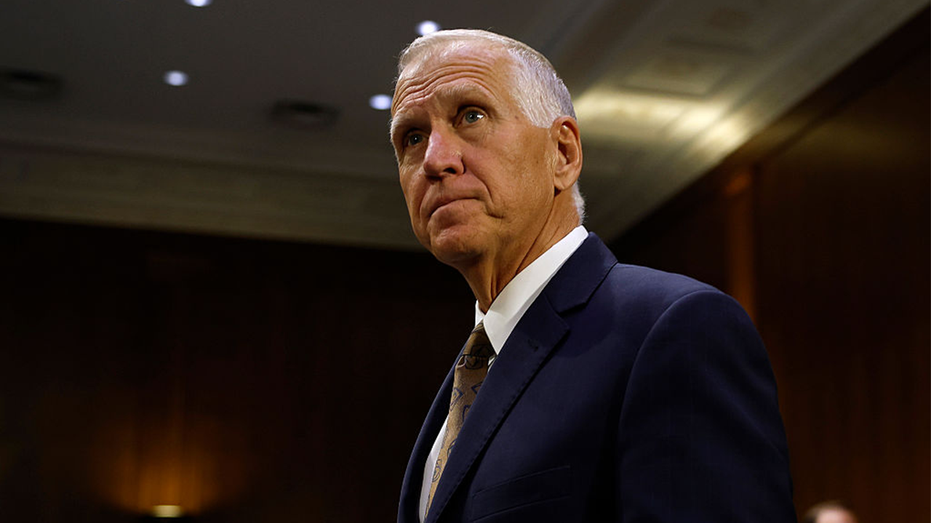
"It's going to be very difficult to get my support for any funding, or any additional resources from Congress until I have a clear, articulated strategy, how this is going to be ramping down over the next 60 or 30 to 35 days. Or, if it's going to be escalated," said Sen. Thom Tillis, R-N.C. "We need a clearly articulated plan if we're going to be there for the long term."
'WE DIDN'T CAVE': THUNE HIGHLIGHTS SCHUMER, DEMS' LOSSES IN DHS FUNDING DEAL
Other Republicans are willing to give the administration some leeway on Iran.
"We can't control the time it's going to take to accomplish the mission. So the mission should be the goal. Not the time it takes to accomplish the goal. We're in it. We need to be in it to win it," said Sen. Cynthia Lummis, R-Wyo. "Look at Vietnam. The reason we lost is because that war was being managed by LBJ from the White House. And when the White House tries to manage the military and call the shots and make the day-to-day decisions, we fail."
This is an apples-and-oranges question, but some Republicans are not-so-quietly getting skittish about how long the U.S. will be on the hook for the war. Especially as the conflict creeps toward the 60-day mark later this month.
"I think it will be solved by then," said a confident Sen. Bernie Moreno, R-Ohio.
But even if the battle is over, it’s probable the U.S. would still maintain military assets in the region. There’s a running cost on that. That bill will come due at some point. And that’s why this reconciliation bill is such a ripe target for additional items like Iran war funding.
But Republicans are already promising an additional reconciliation bill. If the first bill remains lean, GOPers will inevitably push to stash whatever they can in the later package. Still, that’s hard. And with DHS unfunded for so long, that’s why Thune is trained just on approving DHS money.
But reconciliation bills are complex. The House and Senate consumed the entire period from early February through July 3 last year just to pass the One Big, Beautiful Bill Act. Thune and the president want the DHS funding bill wrapped up in the next few weeks. So a third bill?
"Those who tell us that we're going to have a third reconciliation bill have been smoking the devil's lettuce. We will never have a third reconciliation bill," said Kennedy. "This is the last major piece of legislation that we will likely pass until the midterms. There's a feeling which I share among the Senate caucus that this is the last train leaving the station. We had better get all our cargo aboard. Now."
Most diets fail. It’s not a question of willpower. But sometimes dieting is a challenge the deeper you get into it.
The House and Senate are just beginning the current effort to pass the reconciliation bill for DHS funding. It may start out slender, but maintenance is hard.
Here’s something else working against lawmakers: history.
Congress is used to piling lots of things into "must-pass" bills. That’s where the extra parliamentary pounds come from.
Diets often succeed because someone makes lifestyle changes. Will Congress make a "lifestyle change" and pass a reconciliation that only ends the DHS shutdown?
It’s a weighty question.







 English (US)