.png)
This past week, images of Greg Bovino, the chief of the U.S. Border Patrol, spread rapidly across social media as he appeared in Minneapolis flanked by federal agents and shouting orders at protesters. Moving through snow-covered streets, Bovino wore an olive wool, double-breasted overcoat with epaulettes, brass buttons and pointed applied cuffs. Online critics described it as a “Nazi cosplay coat,” and California Gov. Gavin Newsom’s press account on X called it “Nazi-coded.”
Yet while Bovino’s coat shares visual similarities withcertain Nazi uniforms — including theGerman M40 overcoat worn by Kriegsmarine officers — it belongs to a much broader lineage. The double-breasted closure, metal buttons and Ulster collar are hallmarks of the greatcoat, a 19th-century form of outerwear worn by soldiers from many different nations. Members of the Allied forces, includingBritish and American troops, wore greatcoats during the Second World War.Joseph Stalin appeared in one at the 1945 Yalta Conference.
Like field shirts, trenchcoats and combat boots, the greatcoat belongs to a shared military vocabulary that predates fascism and has been used by military forces around the world. And that vocabulary has proliferated out into the broader culture in decidedly not fascist ways: In the BBC series Doctor Who, for example, the Doctor — portrayed as eccentric, humane and resistant to authoritarianism and violence —often wears a similar overcoat.
Although critics fixated on the wrong historical reference, their discomfort wasn’t imaginary. Bovino’s coat may not be a Hitlerian symbol, but it is a symbol for something else: the increasing militarization of immigration enforcement.
Uniforms perform three important roles: They reveal what an institution believes itself to be; they shape how the public sees service members; and they affect how service members see themselves. Psychologists call the third phenomenon “enclothed cognition.” In a widely cited 2012 study, researchers found that participants who wore a white coat they believed belonged to a doctor performed better on attention-related tasks than those who wore the same coat described as something that belonged to a painter. Subsequent studies showed that other types of clothes can shape behavior: suits can make wearers think more abstractly and behave more assertively; medical uniforms can increase the wearer’s empathy; and police uniforms can heighten their threat sensitivity and readiness to use force.
The way immigration officials dress, then, says something about how they view their roles — and, potentially, affects how they behave. Over the last century, the evolution of dress in immigration enforcement tells a story of how such agencies have become militarized.
In the 1950s, Border Patrol agents appeared in public in tailored uniforms that projected civil authority: cropped jackets worn over two-pocket work shirts and dark neckties; pressed trousers marked by stripes running down the leg; brimmed campaign hats drawn from state police and cavalry traditions.
Since then, immigration enforcement has become increasingly martial in character. In 1954, President Dwight D. Eisenhower authorized Operation Wetback, a campaign led by a former Army general that employed military-style tactics to remove migrants. The campaign helped establish a mode of enforcement that later allowed immigration to be reframed as a security issue, a framing that intensified over subsequent decades of partisan immigration debates that focused on drugs, terrorism and crime.. The creation of Immigration and Customs Enforcement in 2002 within the newly formed Department of Homeland Security institutionalized this transformation by situating immigration enforcement inside the nation’s security apparatus.
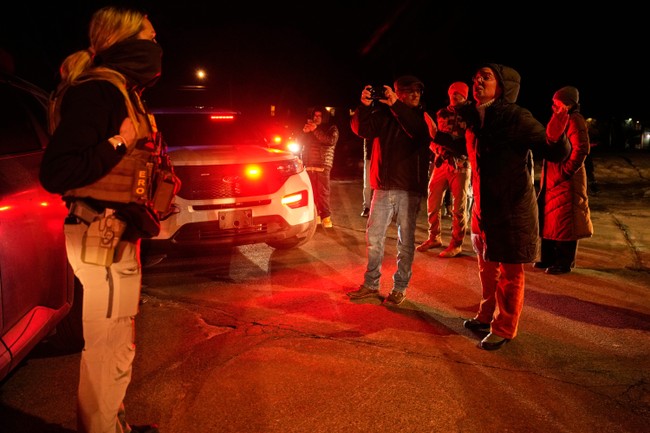
This shift is visible in the evolution of immigration enforcement’s visual language. The campaign hat has given way to ballistic helmets fitted with digital cameras; tailored jackets have been traded for armored vests threaded with MOLLE webbing; pressed trousers have been swapped for cargo pants designed to carry tactical equipment. Faces are partially obscured by balaclavas, names minimized or replaced by unit identifiers. Camouflage patterns developed for jungles and deserts offer no practical concealment on city streets, but they import the visual language of war into U.S. towns and cities.
By dressing immigration enforcement officials in battle-ready attire, the agency encourages agents to understand themselves not as civil servants carrying out administrative law, but as frontline combatants operating in hostile terrain. That shift in self-conception may help partially explain the aggressive tactics ICE officers have deployed in Minneapolis, where they have used chemical irritants against peaceful demonstrators,thrown gas canisters into crowds and, most notably, fatally shot 37-year-old Renée Good. Over time, this produces a self-reinforcing cycle: militarized dress fosters aggressive posture; aggressive posture fuels public fear; and that fear is then cited as justification for even greater militarization.
When a domestic agency dresses for war, it risks acting as if it is at war, even with the public. Clothing alone does not determine conduct, but it can help shape a worldview in which violent confrontation is more likely.






 English (US)