.png)
 1 hour ago
2
1 hour ago
2

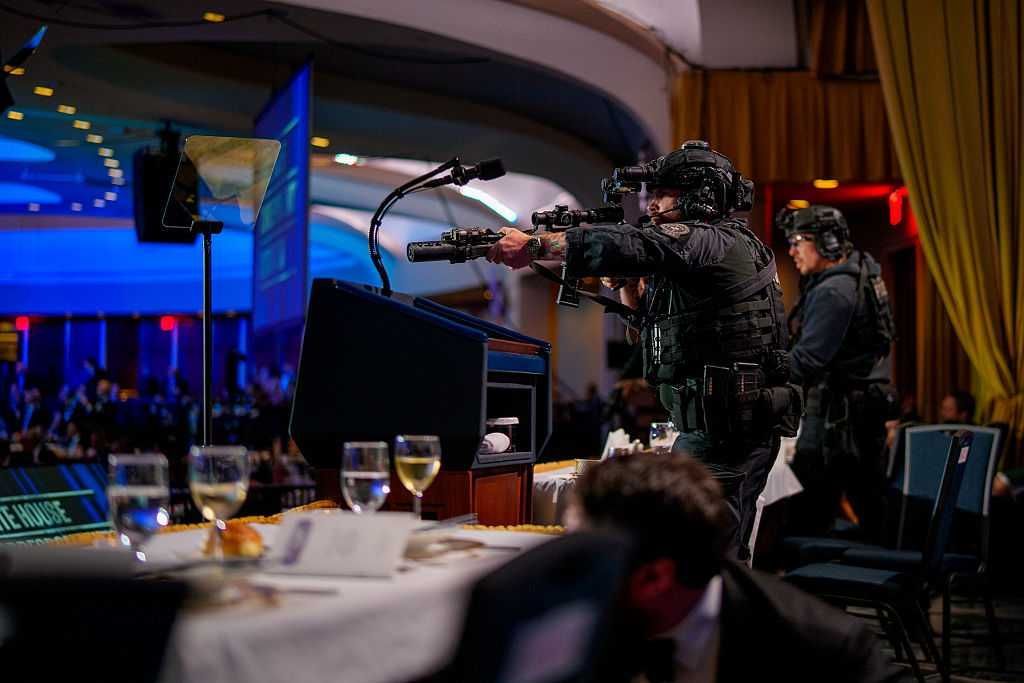
After the nation watched President Donald Trump survive the third credible assassination attempt against him on Saturday, many people have begun wondering what exactly is going on with his security detail, the Secret Service.
For what is thought to be the most elite security detail that protects arguably the most important — and the most targeted — man on the planet, there seems to be an astronomically high number of "security failures," and that doesn't count the many other threats against Trump.
'When the lights came on, a neatly dressed young man, a complete stranger, was standing next to FDR.'
However, a look back at history reveals a remarkable pattern of "failures" to secure the president's person — even aside from the successful assassinations of Abraham Lincoln on April 15, 1865, James Garfield on July 2, 1881, and William McKinley on September 14, 1901.
RELATED: Secret Service accused of trying to 'cover up' motorcade accident involving VP Kamala Harris
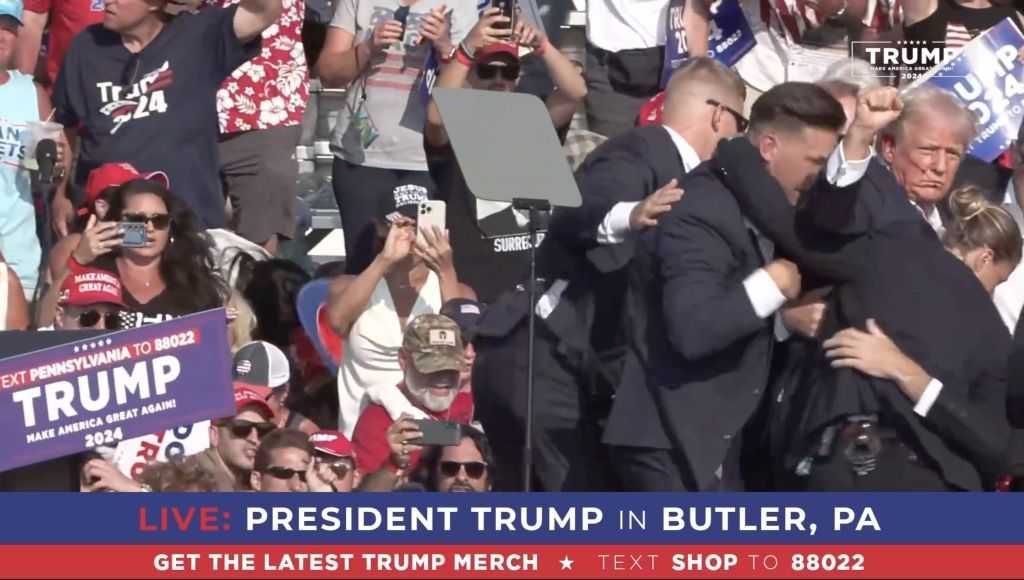 Trump Campaign Office/Handout/Anadolu/Getty Images
Here's a breakdown of some of the most remarkable security breaches since the beginning of the 20th century — after the president's security team supposedly "got serious."
Theodore Roosevelt
Not long after the assassination of his predecessor, President McKinley, President Theodore Roosevelt found himself in harm's way. As the story goes, according to Andrew Tully's book "Treasury Agent: The Inside Story," a man wearing a top hat, white tie, and tails told an usher at the White House that President Roosevelt was expecting him. Though he did not recognize the man's name or expect a visitor, Roosevelt agreed to meet with him in the Red Room. After a few minutes of speaking with the man, Roosevelt summoned the chief usher and told him to "take this crank out of here."
The man was searched after his meeting with the president and was found with a revolver in his back pocket.
Famously, Theodore Roosevelt was shot in the chest while running for re-election in 1912, three years after he left office, but he went on to deliver a speech as planned. However, the Secret Service did not start protecting major presidential candidates on the campaign trail until 1968, so they cannot be blamed for this incident.
William Howard Taft
William Howard Taft's presidency saw what could be described as a more violent threat at the White House. Illinois' the Day Book reported in 1912 that a man identified as Michael Winter, supposedly a German, was arrested "after twice forcing his way into the private part of the executive mansion." According to the Day Book, he reached the White House, "ran swiftly up the steps, dashed past the doorkeeper, and for a moment was lost in the darkness of the hall."
The man, who was later deemed "mentally incompetent" and booked in an asylum as "harmless," explained that he had been twice denied an introduction to President Taft by German Ambassador to the U.S. Johann Heinrich von Bernstorff, but insisted on meeting with him without further explanation: "I want to see the president. I must see him."
Winter was carrying a long blade with a guard to protect the hand "in case it were used as a weapon."
Franklin D. Roosevelt
Though the Secret Service surely learned from these mistakes and beefed up its security measures in the following decades, "slip-ups still occurred," Margaret Truman, President Harry Truman's daughter, wrote in her book, "The President's House: The Secrets and History of the World's Most Famous Home."
In her book, Margaret Truman recounts an almost unbelievable snafu in the FDR White House that is worth quoting in full:
Franklin D. Roosevelt's oldest son, Jimmy, tells a story that the Secret Service would rather forget. One night during World War II, he was home on leave and joined his parents at the White House for dinner. Afterward they watched a movie. When the lights came on, a neatly dressed young man, a complete stranger, was standing next to FDR.Instead of brandishing a weapon, however, the interloper asked for the president's autograph. Somehow, apparently for a lark, he had gotten past the doormen and the Secret Service to penetrate the heart of the house. FDR gave him the autograph and the embarrassed Secret Service men escorted him to the door.
Richard Nixon
In 1974, Army private Robert K. Preston stole a military helicopter from Fort Meade, Maryland, and led two police helicopters on more than an hour-long chase around the D.C. area. He reportedly hovered near the Washington Monument before flying close to the White House. Police shot the helicopter, forcing Preston to land on the White House lawn, where he was tackled and placed under arrest.
Preston was reportedly upset about being a "washout from Army flight training," as the Associated Press reported at the time.
New York Magazine reported that Preston's flight was partially successful, however. Officers described his flying as "masterful."
Gerald Ford
The White House was understandably upset with the Secret Service after Gerald Bryan Gainous Jr. was able to gain access to the White House grounds a total of four times between 1975 and 1976. And it somehow gets worse: Two of those incidents occurred within the span of 10 days.
The New York Times reported at the time that the White House ordered an immediate report from the Secret Service on how Gainous was able to breach the perimeter on the night of November 26 and again during the day on December 6, 1974. On the first occasion, the intruder "spent two hours lurking about the grounds and came within five feet of the president's daughter, Susan, before being apprehended."
Gainous allegedly told police that he was "trying to see the president to seek a pardon for his father, an Air Force sergeant convicted of smuggling drugs."
Ronald Reagan
A New York Times report from January 31, 1985, detailed a White House intrusion in which a man, identified as Robert Latta, was able to "slip into the White House last Sunday and roam around, unchecked, for 14 minutes."
A representative, who shares the intruder's surname but bears no relation to him, explained the strange way the man was able to access the supposedly secure perimeter of the White House:
I understand that a Robert Allen Latta was arrested and charged with unlawful entry at the White House during the inaugural activities. The Secret Service informed me that he had entered the White House with the Marine Corps Band. A court date is set for March 5. He is not a relative of mine, and he is from Denver, Colo. By coincidence I do have a son, Robert Edward, who is an attorney and lives in Bowling Green, Ohio.George W. Bush
On April 9, 2006, Brian Lee Patterson, a New Mexico man who said he had "intelligence information for the president" and claimed that his "family is being poisoned in New Mexico," ran "well inside" the White House perimeter before being apprehended by officers, according to a CNN report at the time of the incident.
His incursion onto the White House lawn was his fourth time jumping the White House fence.
Barack Obama
According to a CNN report, two uninvited guests, identified by the Washington Post as Tareq and Michaele Salahi, were able to gain access to President Obama's first White House state dinner on November 24, 2009.
The couple was able to get close enough for photos with then-Vice President Joe Biden and Obama Chief of Staff Rahm Emanuel, photos which Michaele Salahi reportedly posted on Facebook after the event.
During his congressional testimony regarding the incident, Mark J. Sullivan, the director of the United States Secret Service at the time, said that "a mistake was made":
In our line of work, we cannot afford even one mistake. In this particular circumstance, two individuals, who should have been prohibited from passing through a checkpoint and entering the grounds, were allowed to proceed to the magnetometers and other levels of screening before they were then allowed to enter the White House. Although these individuals went through magnetometers and other levels of screening, their entry into the White House is unacceptable and indefensible.Another event during the Obama administration deserves mentioning. On November 11, 2011, Oscar Ramiro Ortega-Hernandez fired a rifle at the residential wing of the White House at least seven or eight times, according to multiple reports. One bullet struck a bulletproof window on the second floor, steps away from the first family's formal living room. Another got stuck in a window frame, and others bounced off the roof, sending debris to the ground.
Although a tip led to the arrest of Ortega-Hernandez at a hotel in Indiana, Pennsylvania, five days later, the Washington Post reported some remarkable, previously unreported details about the incident.
According to the Post, Secret Service officers "initially rushed to respond." Snipers on the roof, standing only 20 feet away from where one of the bullets struck, were searching for signs of an attack.
However, the officers soon received a surprising order: "No shots have been fired. ... Stand down." The loud sounds were attributed to a backfire from a nearby construction vehicle, contrary to CNN's report that the officers thought that there were gunshots but that they believed the shots were gang-related and not directed at the White House.
It took the Secret Service four days to discover that the White House had been shot at multiple times, and that discovery "came about only because a housekeeper noticed broken glass and a chunk of cement on the floor."
President Obama and first lady Michelle were not in Washington at the time, though their daughter Sasha and Michelle's mother, Marian Robinson, were inside the residence, and Malia was expected to return around the time that the shooting occurred.
Donald Trump
While many people are able to recount the assassination attempts on July 13, 2024, by Thomas Matthew Crooks; September 15, 2024, by Ryan Routh; and April 25, 2026, allegedly by Cole Tomas Allen, President Trump has faced other security threats that should have been prevented much more quickly than they were.
For example, on March 10, 2017, a man identified as Jonathan T. Tran breached the White House grounds and roamed around for 15 minutes before he was arrested by Secret Service agents just steps from the main door. He was reportedly carrying a backpack with mace and a letter for President Trump. According to a CNN report, two Secret Service agents were fired over the handling of the incident.
President Trump was at the residence at the time of the fence-hopping incident.
More recently on February 22, 2026, an armed man was able to breach the perimeter of President Trump's Mar-a-Lago residence. The man, identified as 21-year-old Austin Tucker Martin, was carrying a shotgun and a fuel can.
He was shot and killed by Secret Service agents after they discovered him.
This is not an exhaustive list of threats against U.S. presidents in the history of the Secret Service. The USSS has successfully mitigated countless threats against presidents throughout history, yet the surprisingly consistent security breaches during these administrations may still raise some eyebrows.
Like Blaze News? Bypass the censors, sign up for our newsletters, and get stories like this direct to your inbox. Sign up here!




 English (US)