.png)
CARACAS, Venezuela — At a dance party in a music hall here, hours after reports that President Donald Trump was considering launching land strikes in this Caribbean nation, Halloween costume-clad Gen Zers sipped spicy vodka cocktails, danced to reggaetón blaring through the speakers — and cracked jokes about the possibility of war breaking out as they partied.
“I feel bad for laughing at the thought of something happening and us having to be dressed up in costumes,” said Gabriela, a 20-something wearing a Formula One pilot costume, who runs a small marketing agency here in Venezuela’s capital city.
A few weeks later, at a trendy bar across town, a stylish woman mused with a certain morbid curiosity, “Is it true that they’re striking tonight?” Meanwhile, at an athletic club in the upper-class neighborhood of Valle Arriba, an older woman lounging by the pool confided, “When I go to my [member’s only] beach club, I take my binoculars to see if I catch any warships.”
Throughout Caracas, Venezuelans are going about their daily lives with a peculiar blend of defiance and denial — and sometimes macabre humor —as one after another geopolitical tremor shakes the country. Shoppers queue up in long lines at the opening of the country’s first H&M store. Revelers gather at symphonic Christmas gaita concerts. And beer-drunk fans pack stadiums to partake of Venezuela’s national sport: baseball.
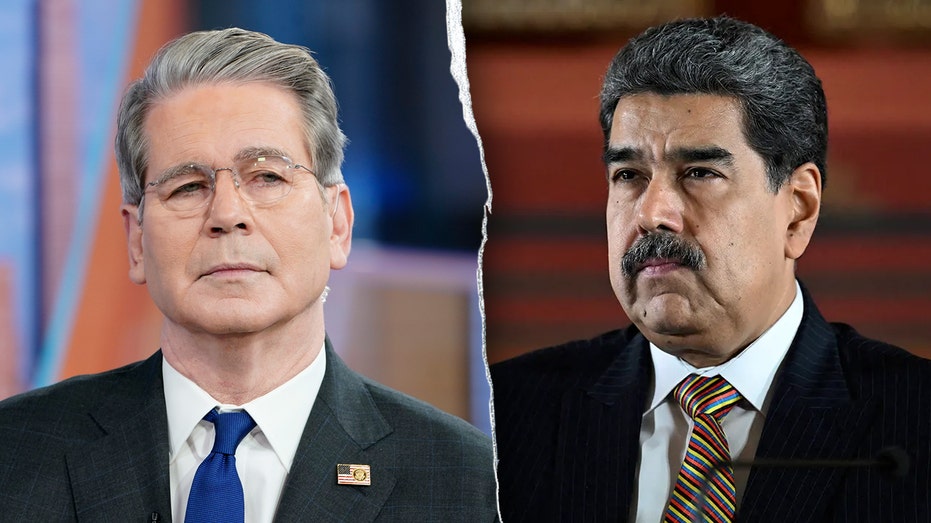
Scenes like this might seem improbable in a country grappling withtriple-digit inflation,humanitarian needs and an authoritarian regime — all while over a dozen U.S. warships and military assets, including a nuclear-powered submarine and the USS Gerald R. Ford, the world’s largest aircraft carrier, are deployed or carry out now-weekly B-2 and F-18 flights near its coasts. While the buildup is nominally framed as a counter-narcotics operation, the Trump administration has labeled Venezuela’s contested leader Nicolás Maduro as the head of a drug cartel, placed a multimillion-dollar bounty on his head and openly discussed forcing him out of power.
And in the past couple of weeks, he’s struck directly at the Venezuelan petro-state’s main source of income: oil. First, he seized a sanctioned oil vessel. Then he ordered a complete blockade of Venezuela, writing on Truth Social, “the shock to them will be like nothing they have ever seen before — Until such time as they return to the United States of America all of the Oil, Land, and other Assets that they previously stole from us.”
Trump appeared to be referring to how, in 2007, Venezuela nationalized ConocoPhillips’ and Exxon’s assets after they didn’t accept new rules for joint ventures with PDVSA, the decades-old Venezuelan state-owned oil and natural gas company, which led to multibillion global legal disputes. Nevertheless, Texas-based Chevron operates in Venezuela under a U.S. license and through a joint venture with PDVSA. As a result, more than 20 percent of Venezuela’s oil exports currently go to the United States.
Trump has said that he was not ruling out going to war with the oil-rich nation, and on Saturday, the U.S. Coast Guard seized another Venezuela-linked oil tanker.
But life here was already complicated for Venezuelans, where citizens zealously avoid talking politics in public due to self-censorship and repression, yet try to carry on — especially during the commercially busy Christmas season.
Venezuelans “mask their opinions because they don't know what kind of reprisals it might provoke,” said Rafael Uzcátegui, a Venezuelan human rights activist who heads a think tank. “This is even more pronounced today.... Except in small circles, caution and distrust prevail among the population.”
These views aren’t surprising when placed in a broader regional context. While a U.S. intervention in Venezuela to oust Maduro remains unpopular among Americans, outside the U.S., Latin Americans are more receptive. According to arecent AtlasIntel–Bloomberg poll, 53 percent support it. (Most of the people surveyed live in Latin American countries with the exception of Cuba, while about 7 percent of respondents live in the U.S. and Canada.) The number climbs even higher among the Venezuelan diaspora, where nearly 64 percent back the idea. Inside Venezuela, the picture is more tangled: 37 percent of respondents say they don’t know, and 34 percent say they do support ousting Maduro — figures that point either to genuine uncertainty or to the kind of guarded, self-censored opinions that have become common under the current climate. After electoral frauds, a humanitarian crisis, repression and failed negotiations, Uzcátegui says, many Venezuelans think, “What other options do we have?”
Since the disputed July 28, 2024, elections, when the government declared Maduro the winner despiteoverwhelming evidence ofan opposition landslide, Venezuela has entered a harsherpost-election crackdown. Hundreds were detained and many more were forced into exile, including opposition candidate Edmundo González. The domestic crisis eventually became an international one: The U.S. ramped up pressure by issuing new sanctions, offering renewed multimillion-dollar rewards for Maduro and his inner circle, and moving to label the alleged Cartel de los Soles — which it links to Maduro — a foreign terrorist organization. Parallel to that, Washington deployed warships and near-daily patrol flights off Venezuela’s coasts.
Meanwhile, María Corina Machado, the popular opposition’s leader who was banned from running, choosing González as her proxy, has grown closer to Trump and Secretary of State Marco Rubio. Earlier this month, she was awarded the 2025 Nobel Peace Prize while in hiding. Later, after 16 months of living in an undisclosed location, Machado escaped the country in a clandestine operation and arrived in Oslo, from where she will begin an international diplomatic tour.
Fear is increasingly a daily feature of life here. According to the United Nations’independent mission on Venezuela and both international anddomestic human rights groups, thousands of Venezuelans have been arbitrarily detained over the past decade for political reasons, with hundreds more arrested in the post-election protests alone: ranging from high-profile opposition figures and journalists to street protesters and ordinary citizens accused of little more thancriticizing the government on a WhatsApp group orprinting shirts with anti-government images.A system for neighbors to denounce “internal enemies,” encouraged by pro-government community organizations and using apps designed for the task, has become a routine tool of social control. The scale of the crackdown is further reinforced by security forces’use of TikTok and other platforms to publicly broadcast raids and detainees, turning arrests into spectacles meant to intimidate.
“No one will tell you what they actually think, at least not completely”, Uzcátegui said, “And this also explains why surveys, asit happened in Nicaragua [before the 1990 elections], are not conducted or are unreliable on certain topics.”
Surveys aren’t a reliable source here, but as a native of Caracas, I've lived here most of my life, and as such I’ve been privy to the hopes and fears of ordinary Venezuelans. (For the purposes of this story, I’ve agreed to only use the first names of the people I interviewed, to protect them from political retribution.)
From talking to scores of locals around the city, I know that across class lines, Venezuelans’ opinions on a potential U.S. intervention seem to toggle between indecision, a desire for a negotiated outcome between the U.S. and Venezuela that could reestablish democracy, fear, and a sort of whispered enthusiasm that an intervention might bring swift political change.
“I completely support this,” Cristina, a graphic designer in wealthier eastern Caracas, told me at a small wedding where people danced and drank whisky despite the political uncertainty of the last few months. “It’s been 26 years [since former President Hugo Chávez and Maduro took power] and they won’t leave by their own will.”
Others look cynically at Trump’s focus on Venezuela. “I don’t think this pressure is for us, but for the riches of Venezuela,” said Nazareth, a gym clerk from 23 de Enero, a low-income neighborhood long associated with grassroots Chavista activism, where pro-government murals, community councils and political organizing have been part of daily life for decades. (Nevertheless, — González won there in 2024, demonstrating that Chavismo’s popularity is faltering today even in its strongholds.)
Living near Venezuela’s Miraflores presidential palace makes Nazareth even more wary: “If they intervene, they won’t care about the people who live here.” Yet her feelings are deeply conflicted. She dislikes Maduro, and even though she insists she wouldn’t want an intervention, she also concedes that she also sort of hopes for it “because everything would change and I’d have more opportunities.”
Others are hoping that a potential regime change would fatten their wallets. “The economic situation is bad, inflation is very high, money doesn’t stretch. Now you can’t even take your kids to McDonald’s or KFC; money is just for groceries,” says Caty, a former Chávez supporter and domestic worker from La Yaguara, a working-class industrial zone in western Caracas.
If the U.S. does invade, Caty says, she hopes “it doesn’t affect us, that they go directly where he is.” On the countryside outskirts of the city, Corotomo, a schoolteacher from El Junquito, believes an intervention could restore democracy: “We can’t vote them out and they own the military and the militia,” she says, but she also shrugs at what she sees so far as “only empty threats.”
In Caracas, whispers, shushes and euphemisms have become common. At an Italian restaurant in Bello Monte, a middle-class neighborhood in southeastern Caracas known for its mom-and-pop shops, leafy streets and small Italian-modernist apartment buildings, a young Venezuelan I spoke to avoided calling Machado by her name despite saying he supports her.
“I hope the lady has a plan”, the young man whispered, glancing around the room, not daring to call Machado by name in public. It seems most conversations these days pass through the now-usual questions: “What do you think will happen?” or “Do you think something will happen?”.
In Chacao, anonymous graffiti announced, “Edmundo won here” and asked for a “Christmas without political prisoners.” But elsewhere, everyone speaks in codes. In his car, before dropping me off, the driver of a ride-hailing app — who recently returned to Venezuela after a few years in Spain — complained about inflation and the cost of living. “Well, I just hope the thing we all hope ends up happening,” he said before finalizing the ride.
When talking with Venezuelans, one realizes this strange version of normalcy has also been fed by the disbelief of many, after years of dashed hopes in repressed protests, disputed elections, and failed opposition strategies, that things can actually change for the better. As a result, the population is now more focused on coping with devaluation and inflation than on political upheaval.
“I do want a change of government, but I don’t see it happening,” said Christian, a young engineer from Chacao. “They've learned to operate under pressure and sanctions.” For him, the chances of an intervention are dim, and sanctions have proved useless to oust Maduro. “Clearly, all of this has had more consequences for us ordinary citizens than for those in power,” he said, adding, “That elite is truly very calm.”
Others are keeping their heads down. “I haven’t followed the news,” Sara, a young psychologist from La Urbina, in easternmost Caracas, told me: “The whole thing gives me anxiety.”
In a way, disbelief or denial have allowed for Venezuelans to accustom themselves to the escalation. The weekly overflights by U.S. warplanes, once a cause of consternation, are now shrugged off.
Similarly, increasinglycommon GPS interference by both Venezuela and the U.S. is now affecting not only domestic and private flights in Venezuela but also day-to-day services such as Waze or local delivery and ride-hailing apps. “I was ordering food from [regional delivery app] PedidosYa and the delivery guy appeared in Antimano” in westernmost Caracas, said Antonio, a manager at a European multinational — even though he was located in Chacao, on the city’s east side.
Others are upset at the occasional disruption of daily life. Due to both NOTAMs and reported navigation interferences, most of the already-limited international commercial flights to Caracashave been cancelled in the last weeks at a particularly sensitive moment. Christmas is when many Venezuelans travel to visit relatives in its 8 million people-strong diaspora, or temporarily welcome thousands of them back home.
Hordes of Venezuelansstarted to leave the country when Chávez, Maduro’s socialist predecessor elected in 1998,pushed the country in an increasingly authoritarian direction and stifled the country’s economy. That political turn was followed by one of thelargest economic contractions in modern history, withnearly 80 percent of GDP wiped out, a hyperinflation spiral and a humanitarian crisis that pushed many million others into exile. Those who stay do so for reasons as varied as family ties, lack of resources, or having found opportunities within an unequal economy, as well as the hope — sometimes stubborn, sometimes fragile — that something will change or that growth is still possible at home.
With flights grounded, the reunions between those that stayed and many who left have been disrupted, including seasonal spending. Weddings and baptisms have also been postponed, as many parents and siblings are stranded in Madrid and other cities and unable to return to Caracas in time for the celebrations. “People cannot come so I’ve had at least four events cancelled in December,” says Mayra, a makeup artist and event organizer who says her holiday income has been affected. “My whole family was coming for Christmas, and we lost all five airplane tickets.”
And yet, even amid the stranded relatives and the perpetually impeding strikes, many Venezuelans find ways to cling to routine, refusing to let uncertainty fully eclipse their Christmas celebrations.
“How’s everything in Caracas? Well, if we are losing it, we’ll lose it all in; we will play dumb till the end,” said Patricia, a local chef, as she watched a parranda Christmas party in the offices of a startup next to her coffeeshop.
“It’s not like it’s the first time we get Christmas ruined. We’ll have fun anyway."






 English (US)