.png)
The defeat of Hungary’s prime minister, Viktor Orbán, should deliver a sharp jolt to one of America’s two major political parties.
Oddly, it’s not the Republicans, deeply invested though they were in Orbán as a fellow traveler.
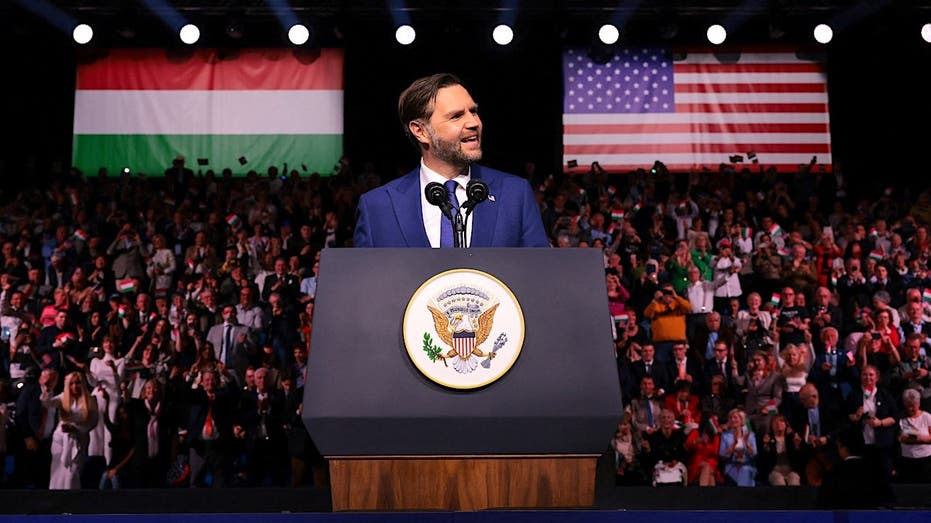
There is no question that Orbán’s downfall is a loss for MAGA-style politics and a reminder that even a developed system of so-called “illiberal democracy” has its limits. President Donald Trump and Vice President JD Vance committed personal credibility and political capital to sustaining Orbán-ism, including by dispatching Vance to campaign for the premier in the final days of the election.
The outcome is a setback for the White House and a humiliation for its best friend in Europe.
But the sharpest message from Budapest should be for the Democrats, strange as that may sound.
That is because Orbán’s ouster represents a new triumph for a particular brand of disruptive politics: one defined by reformist candidates who launch new parties and blow up old ones, winning elections by rendering traditional political structures obsolete. Hungary's Peter Magyar, the leader of the anti-Orbán Tisza party, is the latest victor in this mold. There is no equivalent figure among Trump's American opponents.
This is not just the electoral flavor of the moment in Hungary, an ex-Communist country with a population roughly the size of New Jersey’s — hardly a bellwether for the American electorate. Instead, Magyar joins an eclectic club of successful insurgents scattered from Paris and Rome and Ottawa to Buenos Aires and Seoul and Washington.
There is no ideological coherence to this group. It includes a technocratic former central banker, a conglomerate-bashing former labor lawyer, a chainsaw-wielding libertarian activist and a tariff-obsessed hotel developer-turned-reality TV star. Magyar, 45, was an obscure midlevel official in Orbán’s party before turning apostate in a spectacular defection, armed with a damning secret recording of his spouse who served in Orbán’s government.
What these politicians have in common is a path to power. And it is one that Democrats have resisted for a decade since Trump became the dominant figure in American politics, killing off the traditional Republican Party along the way.
Since then, Democrats have largely hewed to the command-and-control mindset that gave them Hillary Clinton’s coronation in 2016, the party’s abrupt flight to safety with Joe Biden in 2020 and the anointment of Kamala Harris in 2024 without even the pretense of a contested nomination. At least at the national level, Democrats’ political culture prizes order and nonconfrontation, deference to interest groups and demographic symbolism, reverence for norms over original thinking and big ideas.
This has been a bad match for an age of convulsion across the free world.
The American party system is heavily armored against disruption. It would be all but impossible to replicate here what Magyar has done in Hungary — or what France’s Emmanuel Macron and Argentina’s Javier Milei did before him — and turn a fledgling political organization into a personal vehicle and bring it to national power in a flash. We do not have secondary political parties that can surge to prominence in a single campaign, like Giorgia Meloni’s Fratelli d’Italia or Rob Jetten’s D66 in the Netherlands.
Yet as Trump himself has shown, it is possible to devour a major party from the inside — commandeering an old institution with grassroots support, casting aside its entrenched leaders, remaking it in a new image and earning a fresh look from voters who didn’t like the old version. Mark Carney has done something similar in Canada, with a very different political agenda. So has Lee Jae Myung in South Korea.
It takes a special kind of candidate to carry a political project like this, and probably not one likely to win popularity contests with members of a conventional party committee or legislative caucus. Magyar, my colleague Max Griera reported, is viewed by his peers as stubborn, imperious and self-absorbed, and also manifestly the most lethal rival Orbán ever faced. I remember hearing from a senior Canadian lawmaker that Carney was an academic stiff sure to flop in electoral politics, only a few months before he freed the Liberal Party from Justin Trudeau’s shadow and led it to an astonishing upset.
If Democrats want to take the hint, they’ll give a closer look to the leaders frustrating their peers in Washington and defying their home-state political bosses, and less time measuring the applause meter at various special-interest conventions and donor retreats.
And Republicans would be wise to do the same thing, instead of waiting for an unpopular president in his 80s to name his own heir sometime next year, as the Democrats did under Biden.
The strongest successor to Trump — from either party — would not be a ladder climber awaiting his or her turn, but rather someone ready to claim the role through disruption and combat.











 English (US)