.png)
Among the pub-table strategists and commentators in Europe talking about Iran you often hear the phrase, “This is not our war.”
That’s a view as wrong as it is strategically unwise.
Of course it is our war. It is far more our war than America’s. The infiltration of European societies by Islamist networks is further advanced and more acute here than in America. (And solidarity with Israel, whose very existence is under threat, ought to be far stronger in Germany than in the United States.) But even if one believed it was not our war, or even if one were disappointed not to have been briefed on the plans, there remains a potent strain of European society where proclaiming hatred of Donald Trump is greater than sound self-interest. In those circles, one can almost sense something like schadenfreude whenever something goes wrong for the Americans once again.
No matter whether this formulation — that it is not our war — comes from Germany or Finland or elsewhere in Europe, it harms us. First, because it is objectively wrong. Second, because it encourages the common enemy. Third, because it accelerates an American withdrawal of solidarity. Their logic is as simple as it is understandable. If the war in Iran is not a European matter, then the war in Ukraine is not an American one. Then Europeans should solve it themselves in the future, and alone. Ukraine and the Russian aggressor in Moscow are much farther from Washington — mentally and geographically — than the mullahs and their terror are from Berlin or Paris.
For all the uncertainty about America and Israel’s ultimate goals in Iran, I am convinced of one thing: In a situation this critical, in which the Americans are once again pulling Europe’s chestnuts out of the fire, it would be better to stand together. Europe shouldn’t stab the American government in the back as it pursues these efforts.
Europe alone cannot cope
Instead of working behind the scenes to find the right course and the best approach — what used to be called diplomacy — we are staging set-piece clashes in public. We will pay a high price for this unnecessary rhetoric of feeling slighted — rhetoric that, in the end, is only chasing applause at home. Future American governments, too, will remember this withdrawal of solidarity. If we have to cope in the future on our own with both the fight against the Islamism directed from Tehran and the imperial aggression emanating from Moscow, Europe will be overwhelmed.
The transatlantic community of shared interests has sustained and protected us for 80 years, no
matter how complicated, volatile and difficult a U.S. administration has been. At the truly decisive hour, the “we” always prevailed. Now Europe says: I. Or rather: Not me. Europe’s leaders prefer to alienate their partner still further with public lectures. That is not in our interest.
It is naïve to assume that what we see and know is exactly what is happening and being planned in Washington. The only thing we really know is that in situations like this, we know only a fraction of the truth. And that fraction of the truth is that the American government is finally trying to weaken the mullahs’ reign of terror by force of arms. And that is long overdue.
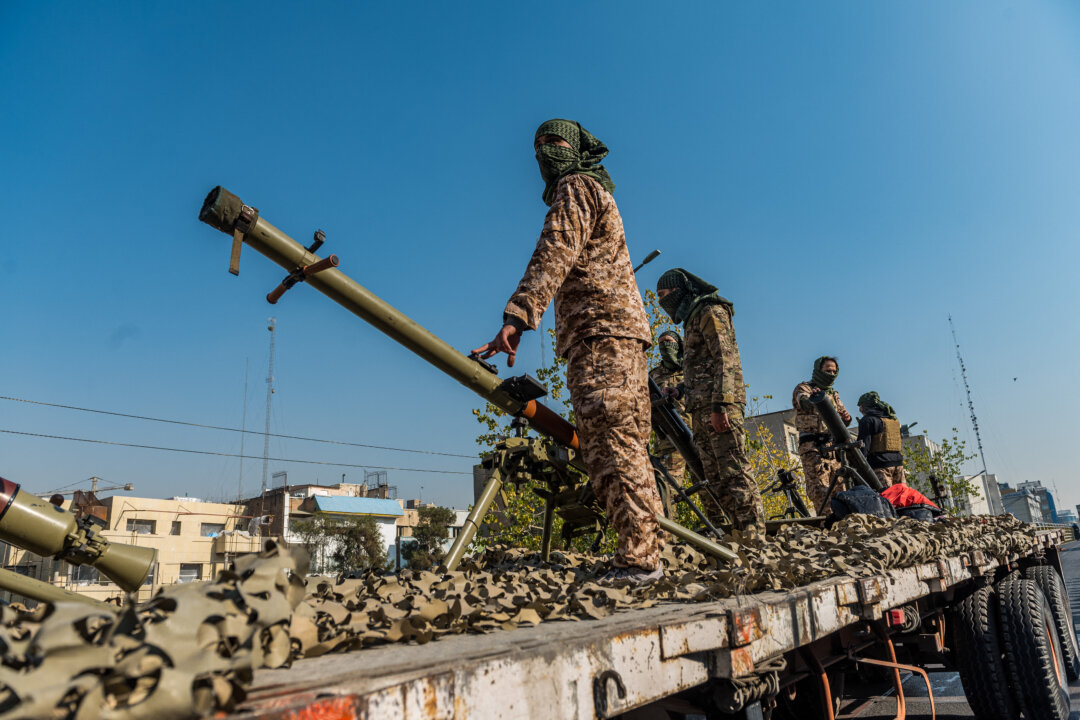
For more than four and a half decades, Iran’s Revolutionary Guards have terrorized the free world. Their goal is not just the destruction of Israel and all Jews, but the destruction of the open society — the godless, decadent liberal democracy they despise precisely because it is free. Our way of life. Our security. Our interests.
For decades, the mullahs have killed not only women they deem dishonorable because they are
unveiled, but also homosexuals. They systematically murder their own people whenever they speak their minds; they murder dissidents — most recently, apparently more than 30,000 of them in a matter of days. With the same ruthlessness and efficiency, the regime in Tehran organizes violence internationally. Together with its terror networks, from Hamas to Hezbollah to the Houthis, the mullah dictatorship is perhaps the most effective and cruel source of terror in the world. They operate in European societies in particular, deliberately spreading hatred and violence in ways that erode our liberal constitutional order and strengthen extremist movements.
The aggressor in Iran — one that poses an existential danger to us — has for years been systematically pursuing nuclear weapons. Nothing — no agreement, no appeal for peace, no presidential handshake — has so far been able to stop it.
For four and a half decades, Western politicians have hesitated to take effective action against this terrorist state, which murders its own people and destabilizes open societies. It was in our European and democratic interest that America and Israel have finally taken joint action to weaken the Iranian regime. Whether the goal is regime change, the removal of 400 kilograms of enriched uranium, simply reducing the hydra-like network of the mullah elite, accelerating an overthrow through popular revolt, or a combination of all these elements — I cannot judge. Some say a first important objective has already been achieved. Iran has been set back by years. We have gained at least one thing: time.
Now Europe needs to stand with the U.S. to make use of it.









 English (US)