.png)
In January 2023, then-Senator JD Vance took to the Wall Street Journal op-ed page to announce his early support for Donald Trump in the 2024 presidential election. The primary reason for his support, he claimed, was that Trump “started no wars.”
“In Mr. Trump’s four years in office, he started no wars despite enormous pressure from his own party and even members of his own administration,” wrote Vance, then just one month into his first term as the junior senator from Ohio. Trump’s refusal to plunge the U.S. into any new foreign conflicts marked “the first real disruption to a failed consensus and the terrible consequences it wrought” — a record that, “more than any single accomplishment, is the enduring legacy of Mr. Trump’s first term.”
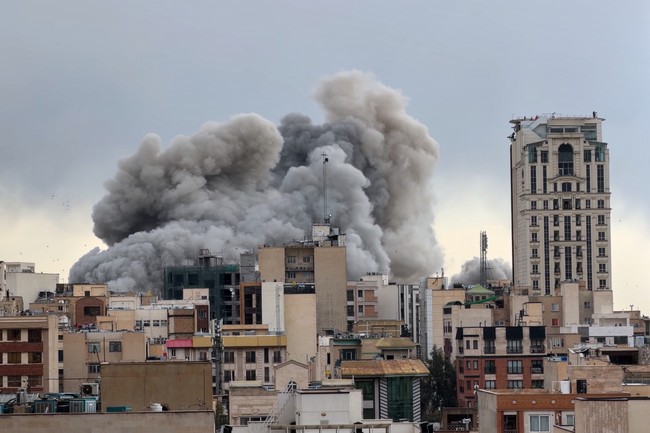
Now, as the Trump administration oversees a far-reaching assault on Iran’s Islamist regime, Vance is participating in a swift reversal of that legacy. The about-face is all the more striking for the vice president, who rose to national prominence as the standard-bearer of MAGA’s anti-interventionist faction that took shape in opposition to the “forever wars” in the Middle East, and which has harshly criticized U.S. intervention in more recent foreign conflicts like Russia’s war in Ukraine. More recently, Vance has positioned himself as a vocal Republican skeptic of war with Iran, arguing as recently as October of 2024 that “our interest, I think very much is not going to war with Iran.”
Against that backdrop, Trump’s attack on Iran appears to be a major political setback for Vance and the anti-interventionist faction on the right — even in the eyes of Vance’s putative allies.
“It’s pretty bad for Vance,” said the leader of a prominent right-leaning nonprofit organization that advocates for a more restrained foreign policy, granted anonymity to discuss sensitive coalitional dynamics. “He had to perform the dutiful task of being the subordinate and trying to convince people like us that this was actually in good hands — and that’s a tough pill to swallow.”
Vance has been circumspect about revealing his role in the administration’s decision to move forward with the strikes. In the lead-up to the U.S. attack, Vance publicly maintained that Trump preferred a diplomatic agreement to prevent Iran from attaining nuclear weapons but was prepared to use military force if necessary — while also arguing that there was “no chance” that a military engagement would evolve into a drawn-out war in the Middle East. On Friday, Vance met one-on-one with Oman’s foreign minister, a key intermediary in the negotiations. When the strikes began early Saturday morning, Vance was in Washington, where he monitored the operation from the White House Situation Room — not with Trump, who oversaw the strikes from Mar-a-Lago alongside White House chief of staff Susie Wiles and Secretary of State Marco Rubio.
In the days since the attacks, Vance has been conspicuously quiet, with his only public activity over the weekend coming on social media, where he retweeted two posts from the White House, including one showing him in the Situation Room during the initial strikes. Vance broke his silence in a brief interview with Fox News’ Jesse Waters on Monday evening, where he defended the attacks, claiming they were in pursuit of the “clearly defined” objective of preventing Iran from attaining nuclear weapons and reiterating his argument that the U.S. is “not going to get into the problems we had with Iraq and Afghanistan.” (Vance’s office declined to comment on his broader involvement in the deliberations surrounding the attacks.)
Vance’s low profile was the subject of speculation at the National Republican Congressional Committee retreat this weekend in Key Biscayne, Florida, where Republicans wondered what to make of Vance’s extended silence on the war.
“People are really fixated that Vance has not tweeted. It’s kind of a huge problem,” said a House GOP official granted anonymity to discuss private conversations. “The fact that he hasn't tweeted — that was kind of what was dominating people's conversations about this, and the fact that he wasn’t with the president.”
Yet what is clear is that Vance’s previously stated position — that a war with Iran does not directly serve American interests — was not the one that Trump ultimately followed. Together with the administration’s recent military operation in Venezuela, that fact is prompting some on the right to reconsider their expectation — fueled by Vance’s rapid ascent within the MAGA movement over the past three years — that Vance and his allies in the administration would serve as an effective bulwark of foreign policy restraint.
“It’s a definite failure of these more restrained anti-interventionist voices that they have been unable to sling things away from that [hawkish] status quo,” said Emma Ashford, a senior fellow at the restraint-oriented Stimson Center.
Some restrainers on the right are acknowledging that recent tactical and political missteps by conservative opponents of war with Iran have contributed to their diminished influence. The nonprofit leader pointed to the failed pressure campaign waged last June led by prominent MAGA-aligned media figures and Vance allies — including Tucker Carlson, Steve Bannon and Charlie Kirk — to dissuade the administration from bombing Iranian nuclear sites as part so-called 12 Day War between Israel and Iran.
“I think that big media personalities like Tucker and Bannon learned a couple of lessons, [including] that the full-court press didn't work — and in fact may have annoyed the president,” they said.
The credibility of the anti-interventionist faction took another hit following Trump’s successful operation to capture Venezuelan president Nicolás Maduro, which did not devolve into the sort of regime-change quagmire that some conservative restrainers feared.
“He’s been very successful at threading the needle between George W. Bush-style intervention and non-intervention,” said Ashford. “That puts [restrainers] on the back foot this time because he been successful so many times recently.”
At the same time, some restrainers are attributing that failure to the inherent limitations of the vice president’s office, which requires its occupants to submerge their own ideological or policy preferences in order to doggedly defend the president. “I think there was an idea of Vance as the national conservative or national populist Dick Cheney, and that's obviously not happening,” said Curt Mills, editor of The American Conservative and a vocal opponent of war with Iran. The nonprofit leader made a similar point, invoking the infamous adage from Franklin D. Roosevelt’s first vice president John Nance Garner that the office “isn’t worth a warm bucket of spit.”
Following both the June strikes on Iran and the subsequent operation in Venezuela, Vance stepped in to serve as the administration’s primary public liaison to the GOP’s anti-interventionist faction, making the case that the operations were consistent with an "America First" foreign policy outlook. In both cases, he largely succeeded at suppressing any major schisms within the movement — but not without a political cost.
“That was him spending down his political capital to support the president,” said Justin Logan, the director of defense and foreign policy studies at the libertarian think tank the Cato Institute and a longtime voice of restraint in Washington. “We’re smart enough to know when it’s our ox being gored.”
This time, though, there are signs that Vance may face stiffer skepticism from his allies. Writing this weekend in the British publication UnHerd, the conservative journalist and long-time Vance ally Sohrab Ahmari sharply criticized the vice president for capitulating to the preferences of the “neoconservative hawks” within the GOP. “The Vance who once sharply critiqued a ‘foreign policy of moralizing’ is overseeing strikes explicitly aimed at freeing the people of Iran,” Ahmari wrote. “For those of us who have been inside these circles and debates, the ironies are mind-boggling.” (Reached by text, Ahmari declined to elaborate on these criticisms.)
Meanwhile, other restrainers who were counting on Vance to behave as a true believer are starting to question the sincerity of his views. “This is a guy who has converted from atheism to Catholicism, the guy who called Trump ‘Hitler’ who is now his vice president,” said the nonprofit leader. “Am I confident that he is entirely moored or tethered to any one perspective or worldview? No.”
The anger directed at Vance stems not only from the fact that he failed to prevent a potentially costly war but also that, in the process, he has done lasting damage to the anti-interventionists’ long-term project of convincing war-weary voters to embrace the GOP as their political home.
For Vance, who is widely expected to seek the Republican nomination for president in 2028, that represents an electoral problem as well as an ideological one. “He wants to build a grand coalition on the right, and I think it's going to be impossible to build a grand coalition by just ignoring the anti-war right,” Mills said. “I think he's going to have to win back some of that support.”
Still, restrainers have not given up on Vance entirely, and many see a possible path back to influence for him and his foreign policy allies. “The investment in Vance was always long-term — buy and hold as opposed to short sell,” said the nonprofit leader. “You need to set the deck and credential the right people so you can actually have an actual recalibration, not just national security and defense strategies that are hardly worth the paper they're printed on.”
Others are counting on the same dynamic that landed them in this position — Trump’s fickleness and susceptibility to reverse course — to eventually bolster Vance and the anti-interventionist’s influence.
“If the war changes, he’ll probably try to sell out the neocons, and he’ll still be the president,” Mills said. “I’m dooming pretty hard … but the reality is that is Trump isn't horrendously ideological, so it feels less baked in than, say, like, President George W. Bush.”
Dasha Burns contributed to this report.







 English (US)