.png)
Let’s deal with one matter right up top. For the past decade we've asked POLITICO’s top European journalists and power players to make an end-of-year judgment about who they regard as the continent’s most powerful player.
This appraisal is intended as a cleareyed recognition of political realities. It is neither an award nor an endorsement.
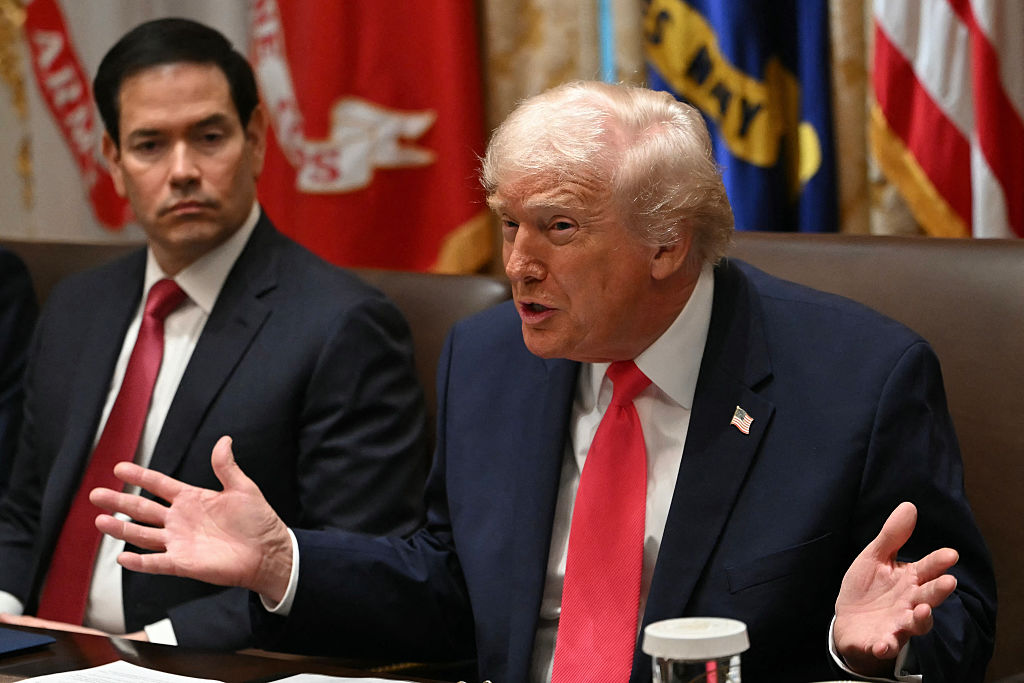
This distinction is important to all of us at the publication, but in a 45-minute interview at the White House Monday, the man being recognized this year—President Donald Trump—made clear that it scarcely matters to him.
He told interviewer Dasha Burns, our White House bureau chief, that he agreed to sit with a publication he sometimes regards skeptically because our news judgment overlapped with his self-conception: The most important European policymaker for the first time in a decade is not a European and, increasingly, doesn’t even much like the place anymore.
Too much immigration, too much crime, too much aimless talk, too much weakness. These derogations were hardly one-offs. They came in a steady stream of criticism, insults, and warnings he portrayed as constructive advice designed to help “decaying” Europe forestall a fatal decline.
It is not Trump’s willingness to be a commentator at large, however, that vaulted a U.S. president to a position of undisputed centrality on the future of Europe. It is because his administration has offered itself as the indispensable broker between Russian President Vladimir Putin and Ukrainian President Volodymyr Zelenskyy for bringing an end to the war on the continent begun almost four years ago, in February 2022, when Russia invaded Ukraine.
Influence over the process, however, isn’t the same as influence over the result. During the 2024 campaign Trump boasted that he would fashion a peace deal in a day. In the interview, he ruefully acknowledged that what he thought would be “the easiest one” to settle has been the opposite. “This one is tough,” he said. “One of the reasons is the level of hatred between Putin and Zelenskyy is tremendous.”
This acknowledgment of the limits, so far, of his diplomacy did not extend to any self-reproach. In fact, he said, the fact that there is any war at all in Ukraine was the result of the two presidents he succeeded in his first and second terms: Barack Obama, who he said did not practice effective deterrence when Putin invaded Crimea in 2014, and Joe Biden, “a low-IQ person” for whom Putin had “no respect.” If he hadn’t been elected to a second term last year, Trump said, “It could have evolved into World War III.”
The interview came at a highly fluid moment in the nearly eight-decade post-World War II alliance between the United States and Europe.
In advance of the interview, as reporters and editors helped Burns prepare her questioning, there was debate in our newsroom about how much the new National Security Strategy released by the White House last week—a document warning of Europe’s “civilizational erasure”—really reflected Trump’s input, as opposed to that of zealous advisers and policy warriors on his team.
Do we really imagine Trump taking breaks from Truth Social and cable TV news to immerse himself in a foreign policy manifesto? He may well not have read it. But there can be no mistaking that in the ways that matter—the strategy’s ideological, cultural, and even psychological foundations—he is its primary author.
Burns asked Trump whether his harsh comments about European allies were a form of “tough love,” designed to stiffen spines and inspire reform, or were actually expressions of contempt toward those he doesn’t want to be allies with at all. He didn’t answer that question with precision, but his words were revealing even so: “I think they're weak, but I also think that they want to be so politically correct. I think they don't know what to do. Europe doesn't know what to do.”
It was clear that when Trump says “Europe” he actually has a critical distinction in mind. Western Europe is the target of his ire. In his view its largest countries and their most storied capitals are becoming immigrant-choked dumps: “I loved Paris. It’s a much different place than it was.” Don’t get him started on London. “If you take a look at London, you have a mayor named [Sadiq] Khan. He's a horrible mayor. He's an incompetent mayor, but he's a horrible, vicious, disgusting mayor.”
Trump said it was only unchecked immigration that allowed Khan to be elected. He also said that immigrants have also begun to disrupt the historically placid cultures of Scandinavia: “So Sweden was known as the safest country in Europe, one of the safest countries in the world. Now it's known as very unsafe — well, pretty unsafe country. It's not even believable.” Germany, he said, had made “two big mistakes” that were both “beauties” under former Chancellor Angela Merkel—who opened borders to refugees from political violence and pursued energy policies that reduced Germany’s energy independence.
By contrast, Trump had generous things to say about several eastern European countries, especially those now ruled by authoritarian-minded leaders. He repeated his praise, lavished many times over the years, on Hungarian strongman Viktor Orbán, and his anti-immigrant stance. He said many people find Turkish President Recep Tayyip Erdoğan difficult but he works with him well: “Whenever they have a problem with Erdoğan , they ask me to call because they can't speak to him. He's a tough cookie. I actually like him a lot. I think actually, you know, look, he's built a strong country, strong military.” Meanwhile, he also had kind words for Poland for limiting immigration.
While Trump offered plenty of opinions about his European counterparts, he claimed none of them are grounded in hard feelings—merely hard-headed appraisals of who is effective and, much more often, who is not.
He thinks now is the time for Zelenskyy to negotiate an end to the war because “you’re losing.” If some European leaders want to help him keep fighting until he wins, “I mean, look, then they should support it”—not look to the United States to carry the load. “I mean, I like all of them,” he said of European leaders. “I have no real enemy. I’ve had a couple that I didn’t like over the years. I actually like the current crew….Some are friends, some are okay. I know the good leaders, I know the bad leaders. I know the smart ones, I know the stupid ones. You got some real stupid ones, too. But they’re not doing a good job. Europe is not doing a good job in many ways.”




 English (US)